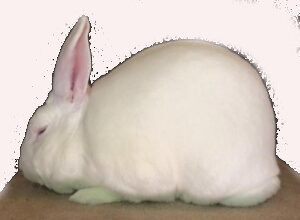

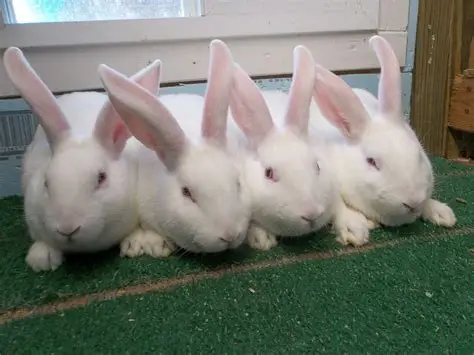
Broad shoulders and deep loin for maximum muscle.
Fast growth rates and excellent feed conversion.
Firm flesh, smooth coat, and strong bone structure.
Calm temperament, ideal for homestead production.
(Recognized as the #1 meat rabbit breed worldwide.)
he Standard for Meat Production — Fast Growth, High Yield
There’s a reason certain breeds rise to the top—not just for a season, but for generations.
In the world of meat rabbits, the New Zealand White stands firmly in that position. Not because of trend or novelty, but because of performance. Consistency. Results.
When people refer to the standard for meat production, they are talking about something very specific:
- Fast growth
- Efficient feed conversion
- Strong, well-developed muscle
- A temperament that supports real-life handling
And again and again, the New Zealand White meets that standard.
Built for Purpose, Not Just Appearance
Unlike many breeds that are appreciated primarily for their visual appeal, the New Zealand White was developed with a clear purpose in mind.
It was bred to:
- Grow efficiently
- Produce quality meat
- Maintain a reliable body type
- Perform consistently across different environments
This is what makes it a commercial breed—every aspect of its structure contributes to function.
When you look at a properly developed New Zealand White, you’re not just seeing a rabbit. You’re seeing a system designed for productivity.
Broad Shoulders, Deep Loin: Where Yield Begins
At the core of meat production is one simple factor:
Muscle.
The New Zealand White excels here, particularly in two key areas:
- Broad shoulders
- Deep, well-filled loin
These are not just aesthetic traits—they are indicators of usable meat.
A wide, well-developed front supports balance and strength. The deep loin, extending through the midsection, is where a significant portion of meat yield comes from.
When these areas are full and properly developed, the rabbit carries weight in a way that is both efficient and valuable.
And importantly, this muscling should feel:
- Firm
- Smooth
- Evenly distributed
Not rough, not patchy, and not overly soft.
Fast Growth Rates: Time Matters
One of the defining advantages of the New Zealand White is its ability to grow quickly.
In practical terms, this means:
- Shorter time to maturity
- Less feed consumed over time
- More efficient production cycles
For homesteaders and breeders alike, time is a resource.
A rabbit that reaches size and condition quickly reduces:
- feed costs
- labor
- overall input
This is one of the key reasons the breed has become so widely used—it performs not just well, but efficiently.
Feed Conversion: Getting the Most from What You Give
Closely tied to growth rate is feed conversion.
This is the ability of the rabbit to turn feed into body mass.
The New Zealand White is known for:
- Excellent feed efficiency
- Reliable weight gain on consistent feeding programs
This means you’re not just feeding more—you’re feeding smarter.
A well-managed New Zealand White will:
- utilize feed effectively
- maintain condition
- grow at a steady, predictable rate
This predictability is invaluable, especially when working within a homestead or production system.
Structure That Supports the Whole Animal
Beyond muscle and growth, structure plays a major role in long-term success.
A proper New Zealand White should have:
- Strong bone structure
- Balanced proportions
- A smooth, continuous body line
This supports:
- healthy movement
- proper weight distribution
- durability over time
Combined with:
- a firm flesh condition
- and a smooth, dense coat
The overall effect is a rabbit that is not only productive, but well-built.
Calm Temperament: A Practical Advantage
One of the most underrated traits in a meat rabbit is temperament.
The New Zealand White is known for being:
- Calm
- Manageable
- Steady in handling
This matters more than people expect.
In real life, rabbits are:
- handled
- fed
- moved
- cared for daily
A calm temperament makes all of this easier.
It reduces stress—for both the animal and the handler—and creates a more stable environment overall.
For homesteaders especially, this can be the difference between a system that works and one that becomes difficult to maintain.
Why It Became the #1 Meat Rabbit Breed
When you combine all of these traits:
- Muscling
- Growth rate
- Feed efficiency
- Structure
- Temperament
You start to see why the New Zealand White has earned its place.
It is widely recognized as:
The #1 meat rabbit breed worldwide
Not because it excels in just one area—but because it performs well across all of them.
It is balanced. Reliable. Proven.
Bringing the Standard Into Real Life
Understanding the standard is one thing.
Applying it in real life is another.
Because no rabbit exists in a vacuum.
Every animal reflects:
- its breeding
- its feeding
- its environment
- its daily care
And this is where experience begins to matter.
What It Looks Like in Practice
At a working rabbitry, the goal is not just to meet the standard—but to live it out consistently.
That means:
- selecting for structure and temperament
- maintaining feeding routines that support growth
- raising animals in a way that reflects real use
Not just for show—but for function.
At Silver Ridge Rabbitry & Farms, this approach is at the core of how New Zealand Whites are raised.
The focus is on:
- strong, balanced bodies
- steady growth
- animals that handle well and perform reliably
Not as an ideal—but as a daily practice.
👉 You can see how that comes together here:
Silver Ridge Rabbitry & Farms
A Breed That Fits the Homestead
For many people, the goal is not large-scale production—it’s sustainability.
A system that works within:
- available space
- available time
- available resources
The New Zealand White fits this model well.
It offers:
- efficiency without complexity
- productivity without excessive input
- reliability that supports learning and growth
Whether you are just starting or refining an existing setup, it provides a strong foundation.
The Difference Is in the Details
At a glance, many rabbits may appear similar.
But when you begin to look closely, the differences become clear.
You start to notice:
- the depth of the loin
- the width through the shoulders
- the firmness of the flesh
- the steadiness of the temperament
These are not surface traits.
They are indicators of how the animal will perform.
And over time, those details matter more and more.
Final Thoughts
The New Zealand White is not just a breed—it is a benchmark.
A standard by which other meat rabbits are often measured.
Because it brings together:
- efficiency
- structure
- temperament
- consistency
Into one complete animal.
And when raised with care and intention, it delivers exactly what it was designed to do.